
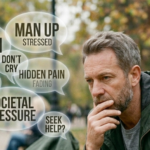
Think about the men in your life; a father, brother, grandfather, friend, husband, partner, or uncle. And if you identify as a man, think about yourself and the last time you said without deflecting or following it up with a joke: “I am not okay” or “I need help.”
Chances are, you’re drawing a blank.
We are not talking about biology. It is societal conditioning.
Is this because men don’t struggle? Or because society has spent decades telling them to “man up” and “men don’t cry”? Through the media, relatives, your own fathers, teachers, and in some cases, the very people who raised you. Research confirms that unhealthy masculinity norms significantly impact emotional awareness and expression among men. And when men do express vulnerability, they are quickly labelled as weak or unmanly among other slurs.
Men are not born emotionally closed off. This is a learned survival mechanism. Which means it can be unlearned. And it is precisely this conditioning that keeps men from seeking mental health support.
And why does it seem easier to talk to an alien than another human?
Research tells us that men die by suicide three to four times more than women. That is three to four men for every one woman. Let that number sink in. And more often than not, it is because of the very societal expectations that stop men from seeking help in the first place. These are real people with real relationships. People who have been holding on more than they can carry, suffering quietly possibly for years, simply because they were never given permission to be otherwise. These numbers live inside the same silence we have been talking about. And sometimes, we may find them in unexpected places.
Think about the athletes we idolise so much. Virat Kohli speaking openly about experiencing mental exhaustion and stepping away to take care of his mental health. Michael Phelps openly admitting to the world that he experienced thoughts of taking his life after the 2012 Olympics. These are not weak men. These are simply men who performed at the highest level possible and still continued to experience mental exhaustion. If the cost of silence was that high for them, imagine what that would look like for the rest of us carrying it quietly with no media attention/coach around us.
I watched Andy Weir’s novel turned movie Project Hail Mary recently. In just a few days of connecting with Rocky, Ryland expressed sadness, grief, happiness, excitement, anger, hurt, and love, all while being stranded in space. He found creative ways to communicate and draw boundaries without giving up. And somehow, talking to an alien felt more possible than talking to another person.
Why does that resonate so deeply?
Because most men are not waiting for the right words. They are waiting for proof that the other person can handle them.
The barrier isn’t just willingness, it’s permission
Men are capable of breaking gender norms. They are capable of drawing boundaries and freely expressing emotion. So what’s stopping them even today?
They are simply unsure whether they are allowed to.
In my professional experience of working with adolescent and adult men across different backgrounds, one theme recurs consistently: men suppress their struggles not because they don’t feel, but because they fear being perceived as weak or unmanly and the judgment of peers, family, and society feels too costly.
That’s not emotional unavailability. That’s someone who has learned, very thoroughly, that the cost of being seen is too high.
What unlearning actually looks like
It looks like one honest conversation. One session where nobody expects you to have it together. A space where your words won’t be held against you, where expressing emotion is witnessed as a strength, not weakness. Where you begin to unlearn the patterns that no longer serve you and build a version of yourself that does.
I have sat with men who came in saying they didn’t know why they were there, and left having said things they’d never said to anyone. And it is not a miracle but simply something that happens when the environment is right.
Men do disclose difficulties, including anxiety, in therapeutic settings and within trusted relationships where they feel safe and know the other person won’t flinch. And while the shape of this conditioning varies across cultures and generations, its impact on men’s willingness to reach out is remarkably consistent. The capacity is there. It always has been. What changes is the environment.
A note directly to the men reading this
You don’t have to call it therapy. You don’t have to have a reason that feels big enough. You don’t have to be in crisis. You just have to have a little courage to show up for yourself.
That is more than enough to begin.
At Raaiter Wellness, this is a space where all of it is welcome. The things you’ve never said out loud, the feelings you’ve talked yourself out of, the version of you that exists underneath the one that’s always fine.
Whenever you’re ready, I’d love to hear from you.
Please Note:
If you are currently experiencing thoughts related to harming yourself or suicide, please contact your local emergency helpline immediately.
References:
- Cleary, A. (2022). Emotional constraint, father-son relationships, and men’s wellbeing. Frontiers in Sociology, 7. https://doi.org/10.3389/fsoc.2022.868005
- Notredame, T. Delbarre, Pauwels, N., L. Rougegrez, Metz, G., & M. Morgiève. (2025). Enhancing men’s engagement in suicide prevention: Integrating masculine norms and personal narratives. European Psychiatry, 68(S1), S369–S369. https://doi.org/10.1192/j.eurpsy.2025.774
- Mokhwelepa, L. W., & Sumbane, G. O. (2025). Men’s Mental Health Matters: The Impact of Traditional Masculinity Norms on Men’s Willingness to Seek Mental Health Support; a Systematic Review of Literature. American Journal of Men’s Health, 19(3). https://doi.org/10.1177/15579883251321670
- Kurian, M. J., & Levant, R. F. (2025). The Mediating Role of Normative Male Alexithymia on the Relationship Between Traditional Masculinity Ideology and Emotional Intelligence Among Indian Men. The Journal of Men S Studies. https://doi.org/10.1177/10608265251360681